Te’mexw Treaty Negotiations
On this page…
- Te’mexw Treaty Negotiations
- 2026 public open houses
- 2023 engagement
- About the 5 modern treaties with the Te’mexw Member Nations
- Consultation with neighbouring First Nations
- Learn more
Overview
Who: Government and the 5 Te’mexw Member Nations
What: Treaty negotiations
Where: Vancouver Island
Why: To advance reconciliation
How: In-person, online
Te’mexw Treaty Negotiations
Established in 1994, the Te’mexw Treaty Association (TTA) is a non-profit society negotiating modern treaties on behalf of its five Member Nations:
- Malahat
- Beecher Bay (SC’IȺNEW̱)
- Songhees
- Snaw-naw-as (Nanoose)
- T’Sou-ke
open
Contact us: Temexw.Treaty@gov.bc.ca
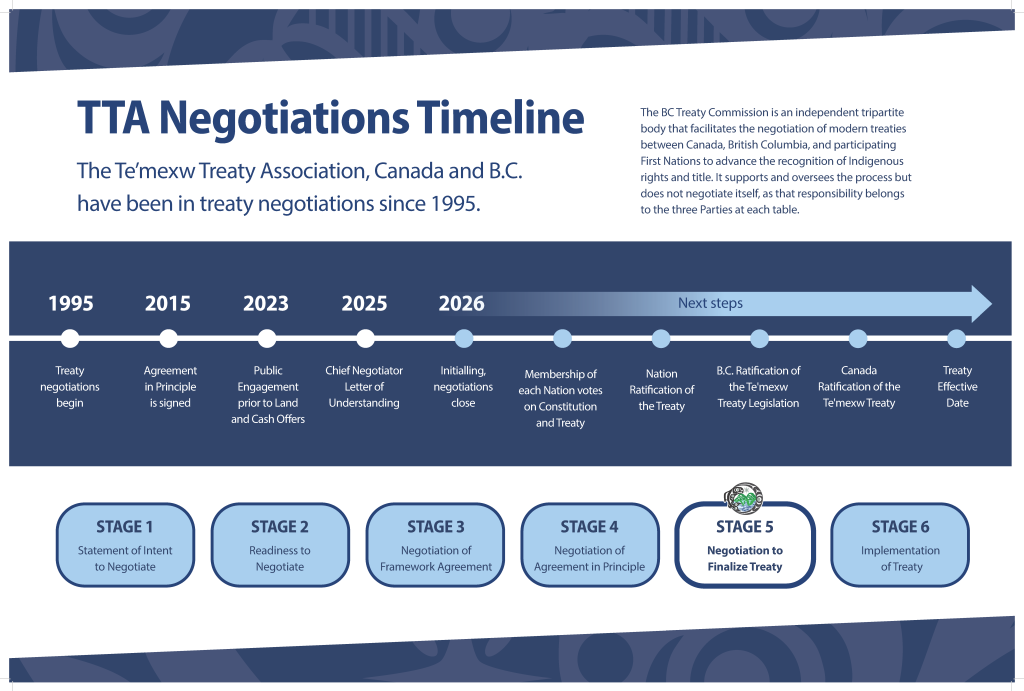
TTA, Canada and British Columbia have been in negotiations since 1995. Treaties are part of Canada and British Columbia’s work to advance reconciliation guided by the United Nations Declaration on the Rights of Indigenous Peoples (UNDRIP) (PDF, 150KB), the Truth and Reconciliation Commission’s Calls to Action (PDF, 300KB) and the Recognition and Reconciliation of Rights Policy (PDF, 300KB) for treaty negotiations in British Columbia. Although the five Te’mexw Member Nations are negotiating together, the negotiations will result in five separate treaties.
An Agreement-in-Principle (Stage 4) was signed in 2015, which identifies interests in lands and resources and includes a framework for self-government, financial arrangements and more. It forms the basis for the treaties. Read the Agreement-in-Principle (AIP) (PDF, 12MB).
These negotiations are now in Stage 5 of the B.C. Treaty Commission treaty process, and there will be future engagement opportunities before the treaties are signed and come into effect. Read about the treaty process and different stages.
Once negotiations are concluded, members of each Te’mexw Member Nation will have an opportunity to vote on their treaty. The treaty also must be approved by B.C. and Canada before it comes into effect.
Learn more about the TTA negotiations: view maps of the proposed treaty lands (PDF, 5MB).
2026 public open houses
In June 2026, B.C., Canada and TTA hosted a series of open houses in Sooke, Victoria, Shawnigan Lake, and Lantzville for the public to learn more and ask questions about the five distinct treaties, building on previous engagement. These open houses were intended to share information on the work underway and support public awareness, understanding and constructive community dialogue.
Read the May 29, 2026 information bulletin.
If you were unable to attend an open house but have a specific question that is not answered from the page content, please contact Temexw.Treaty@gov.bc.ca.
View the poster boards (PDF, 18MB) for general information shared at the in person open houses about the five Te’mexw Treaties.
The treaty partners aim to support public understanding of the treaties and their potential impacts. Engaging with local governments, people and businesses with interests in land to be transferred, and the public is important for everyone at the treaty table. This engagement has been ongoing and will continue through this final stage of negotiations. It helps to build awareness and understanding of the Te’mexw Member Nations’ modern treaties as a step towards reconciliation and supports long-term good neighbour relations.
2023 engagement
Thank you to everyone who attended the in-person and virtual open houses in Spring of 2023. Here is the presentation from the virtual open house (PDF, 5MB).
From February to May 2023, TTA, B.C. and Canada engaged with local communities in the Te’mexw Member Nation territories on Southern Vancouver Island to raise awareness about treaty negotiations coming to a close.
In early May 2024, the Ministry of Indigenous Relations and Reconciliation, Canada and TTA released a What We Heard Report, which describes the engagement activities and participation rates for the 2023 open houses, including feedback and questions collected during the engagement process, along with responses given by the negotiating partners.
Read the What We Heard Report (PDF, 2MB)
About the 5 modern treaties with the Te’mexw Member Nations
Modern treaties in B.C. are among the highest forms of reconciliation between First Nations, the Government of British Columbia and the Government of Canada.
Treaties are constitutionally protected agreements, capable of evolving over time (commonly referred to as “living agreements”) that are negotiated between the three parties.
They are grounded in the recognition of First Nations’ rights and provide a process for the reconciliation of Crown title and the First Nations’s rights and interests in land and governance, and the reconciliation of pre-existing Indigenous sovereignty with Crown sovereignty.
Treaties include:
- Recognition and reconciliation of rights
- Self-government
- Lands
- Outlined jurisdiction over natural resources, land-use, culture, and social topics, including health and education on Treaty Lands and over Treaty Members
- A process to discuss shared decision-making
- Fiscal relations
These are important treaties for everyone in these First Nation territories. They will help create opportunity and certainty for people who live and work on Southern Vancouver Island and reflect significant progress in the journey of reconciliation.
The treaties will encourage investment by creating certainty and clarity, create jobs, expand economic development and support social well-being for Beecher Bay (SC’IȺNEW̱), Malahat, Snaw-naw-as (Nanoose), Songhees, and T’Sou-ke First Nations’ communities.
Treaty lands
Treaty lands will be located within each Treaty Nation’s territory once the treaty reaches its effective date (should the treaty be approved and ratified). The government of each Treaty Nation will be able to make decisions and laws over topics including the operation of its government, land-use, natural resources, culture, and social topics, such as health and education. Treaty lands are not subject to local government zoning. Each Treaty Nation will manage, zone, and develop its treaty lands and will undertake land use planning for treaty lands to determine how best to use the lands.
The B.C. treaty negotiations process has always been guided by the principle that private property (fee simple land) is only on the negotiation table on a willing-buyer, willing-seller basis. Private fee simple property rights are protected through this process. The proposed treaty lands for the TTA Member Nations do not include privately owned fee simple lands, except lands already owned by the respective TTA Member Nations.
Pre-approved additions are potential future land purchases identified by the First Nations as being interested in purchasing on a willing-buyer, willing-seller basis in the future. To be clear, these parcels do not become treaty lands when the TTA Treaties come into effect. The TTA Treaties will NOT have a direct impact on the owner’s fee simple rights. Each individual TTA Member Nation identified these parcels as pre-approved additions due to the location adjacent or near to their proposed Treaty Lands. Pre-approved additions are specific to each individual TTA Member Nation and are not shared across the five First Nations.
Park lands
Two B.C. Parks are being offered as Treaty Lands in two of the TTA treaties:
- Discovery Island Marine Provincial Park for Songhees Nation
- Sooke Mountain Provincial Park for T’Sou-ke First Nation
As part of the agreement, public access and recreational opportunities will continue and conservation values will be maintained.
Self-governance and law-making authorities
Treaties recognize the inherent right of First Nations to self-govern and set out the authority to establish laws over matters integral to the Treaty Nation’s governance, such as certain programs, services, and lands and resources. First Nations will have the right to create self-government laws when they are prepared to exercise that authority; otherwise, relevant federal and provincial laws apply.
Treaties empower First Nation governments to participate in regional government bodies as voting members. They can enter into servicing agreements with local governments and work collaboratively with local governments on land-use planning.
Each First Nation will have authority to make decisions over resources on their respective treaty lands, as set out in each treaty. The treaties also provide opportunities to negotiate with B.C. and Canada on the collaborative management of resources.
Each of the five Te’mexw Member Nations will have the right to self-govern and make laws concerning their Treaty Lands and citizens. Law-making authorities include:
- Lands and Resources
- The exercise of Treaty rights
- Adoption
- Child and family services
- Aboriginal healers
- Health services
- Family and social services
- Marriage
- Childcare
- Language
- Kindergarten to Grade 12 education
- Post-secondary education
- Culture and Heritage
Consultation with neighbouring First Nations
Canada and B.C. have the duty to consult and, where appropriate, accommodate when the Crown contemplates conduct that might adversely impact the potential or established section 35 rights of neighbouring First Nations. Canada and B.C. have consulted on the key milestones of negotiations throughout the BC Treaty Commission treaty negotiations process. Consultation remains ongoing.
Learn more
Find out more about the Te’mexw Member Nations:
- Te’mexw Treaty Association: We Are The Te’mexw Treaty Association – YouTube
- Te’mexw Treaty Association: www.temexw.org
- https://scianew.com/
- malahatnation.com
- snawnawas.org
- songheesnation.ca
- tsoukenation.com
Additional links:
- BC Treaty Commission
- B.C. Declaration on the Rights of Indigenous Peoples Act
- Te’mexw Treaty Association Agreement-in-Principle (AiP) – 2015
- Malahat Incremental Treaty Agreement – 2013
- Beecher Bay (SC’IA⁄NEW) Incremental Treaty Agreement – 2013
- Songhees Incremental Treaty Agreement – 2013
- Snaw-Naw-as (Nanoose) Incremental Treaty Agreement – 2013
- T’Sou-ke Nation Incremental Treaty Agreement – 2013
Contact us: Temexw.Treaty@gov.bc.ca
Related engagements