Secretive sharp-tailed snakes in the Salish Sea
Categories:
Guest blog by Laura Matthias, ecological consultant
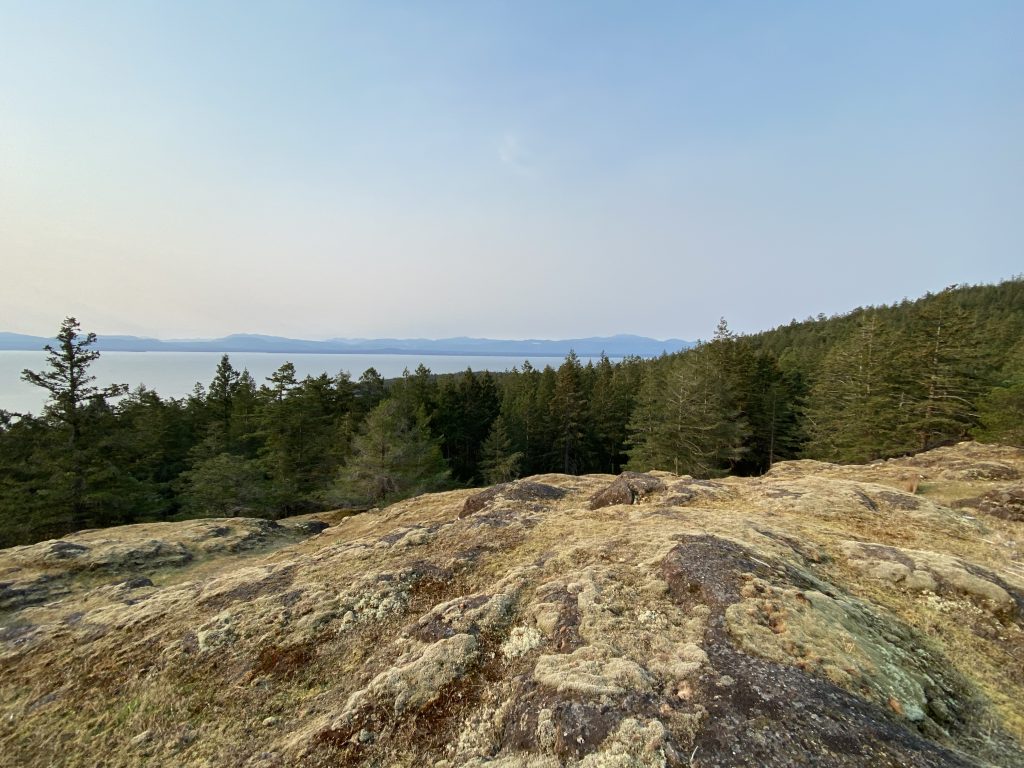
Lasqueti Island is found within the Salish Sea, with around 500 people living on the off-grid island. Its rugged shorelines and diverse habitats fall within B.C.’s smallest and rarest ecological zone known as the Coastal Douglas-fir Biogeoclimatic zone. These ecosystems support unique biodiversity, warm Mediterranean-like climates, and many rare species.
One unique, rare species was recently discovered on Lasqueti Island – the sharp-tailed snake (Contia tenuis). This snake spends most of its life underground, often burrowed into rotting logs, tree stumps, or under rocks. Its secretive nature makes it challenging to find, as does its size – it’s the smallest snake species found in B.C. Young snakes are a brighter reddish-orange colour, and they are very small, weighing less than half a gram and measuring about 8-10 cm. To put it in perspective, a young snake weighs as little as half a jellybean and is the length of a crayon. Older snakes become a duller brownish-red colour and can grow up to 30 cm in length and about the thickness of a pencil. These non-venomous snakes get their name from a thornlike scale at the tip of their tails, which contrast with the smooth scales on the rest of their body. Unlike garter snakes which lay live young, sharp-tailed snakes are egg-laying and need warm sunny locations for their eggs to incubate. They are usually found in open, south or southwest facing exposures often in Garry Oak and Coastal Douglas-fir ecosystems.
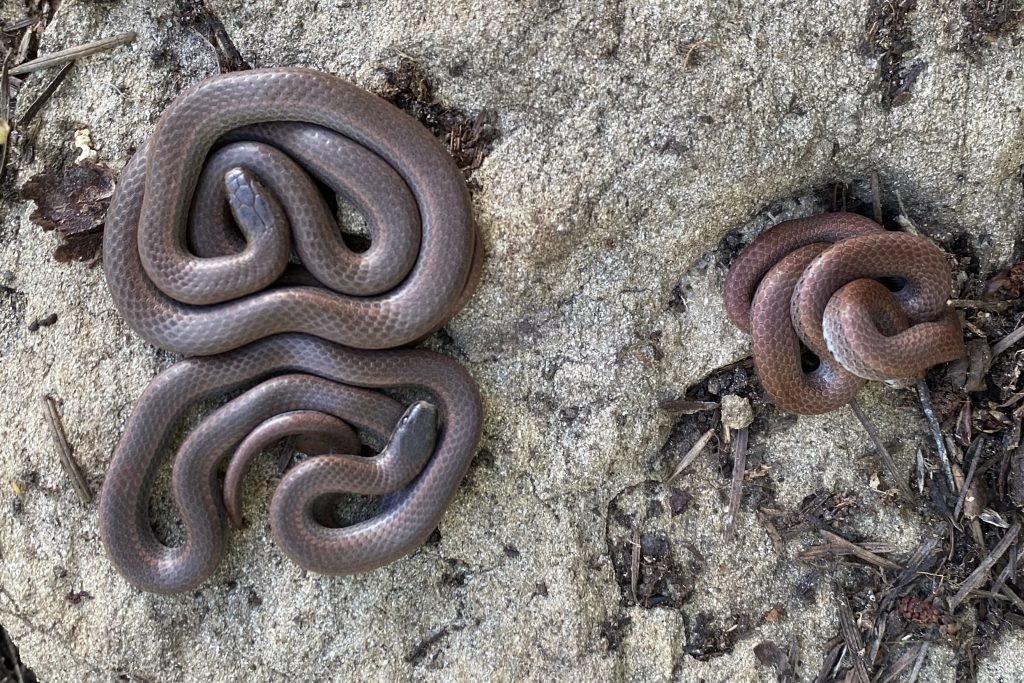
In May 2023, a sharp-tailed snake observation on INaturalist was confirmed on Lasqueti Island. This discovery extends the known range of the species by over 60 km—previously the coastal population was known to live on the southern Gulf Islands and on southern Vancouver Island, but no further north than Ladysmith. With this exciting new find, more surveys and monitoring will help determine the distribution of the snakes on Lasqueti Island.
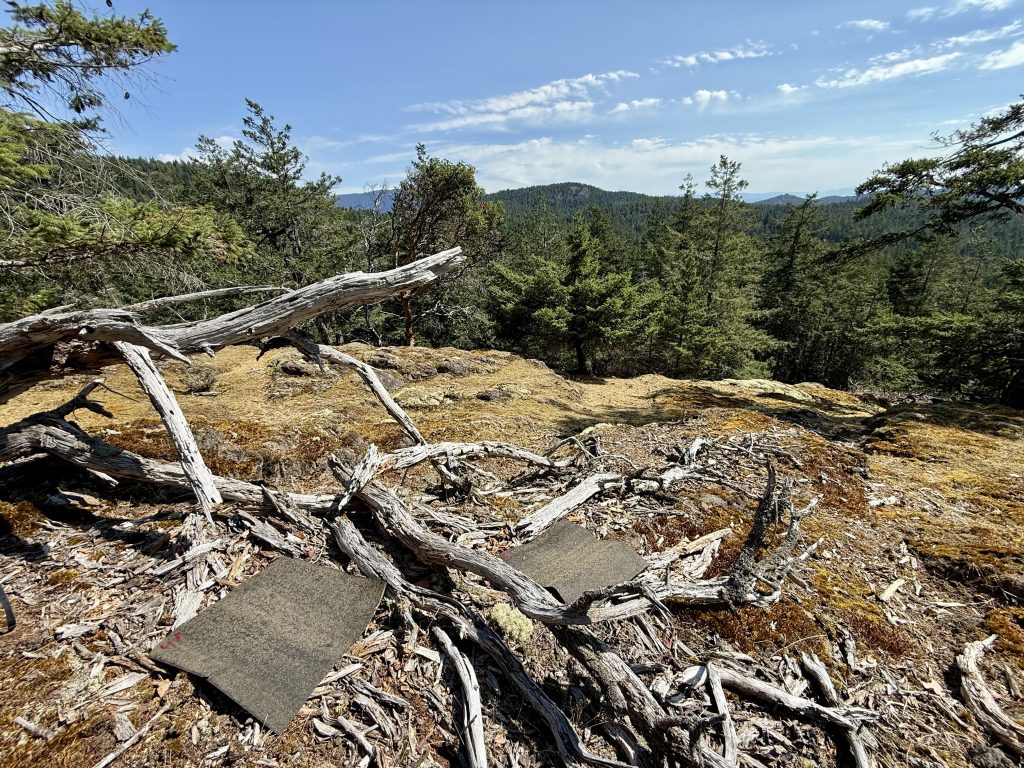
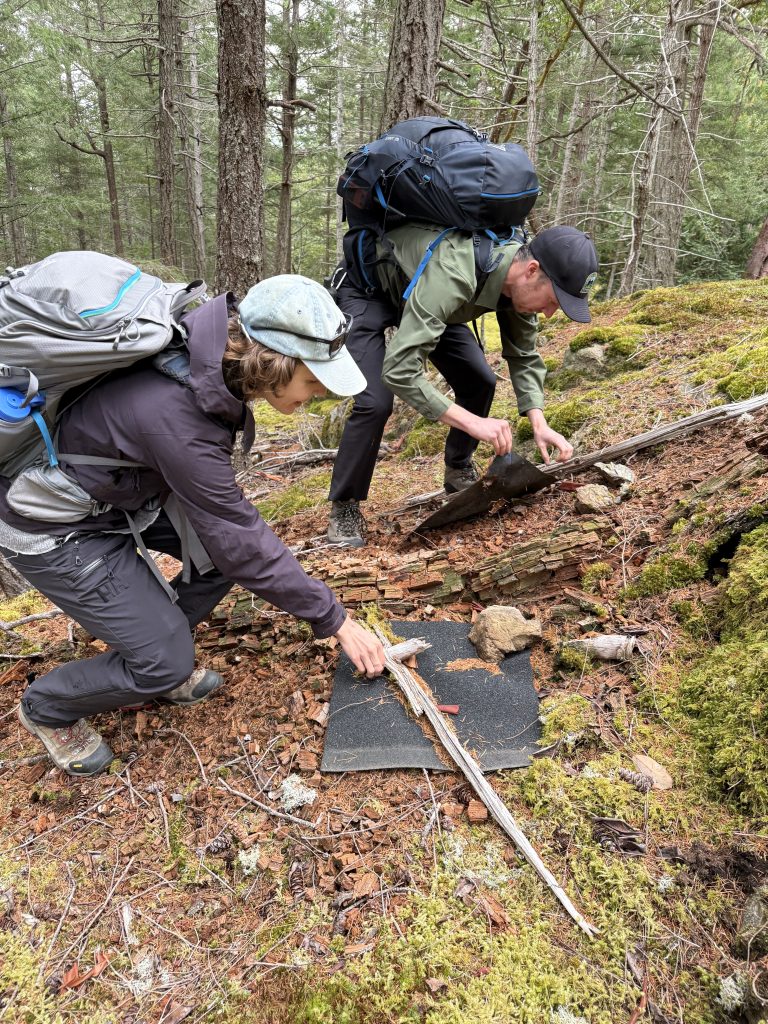
In collaboration with BC Parks, Lasqueti Island Nature Conservancy (LINC) and staff with the province of British Columbia, Laura Matthias, a member of the Sharp-tailed Snake Recovery Team, visited Lasqueti Island in 2024 and 2025 to set up artificial cover objects (ACOs) to try to find additional sharp-tailed snakes on the island. ACOs are small asphalt shingles that are placed on the ground in habitat that the snakes might use. Snakes naturally warm up under rocks or rotting wood and logs, but they will also use the ACOs. Researchers look for the snakes under the ACOs on warm sunny days, which allows them to find the small snakes without disturbing or destroying their natural habitat.
One of the sites where ACOs were installed was the Lasqueti Island Ecological Reserve, which was established in 1971 to protect important marine shoreline habitats, rare species, and Coastal Douglas-fir ecosystems.
Ecological reserves protect special natural ecosystems, and support research and education. They are not intended for outdoor recreation. However, this ecological reserve is open to the public for non-destructive activities like hiking, nature observation and photography.
Staff from BC Parks and LINC joined Laura Matthias to visit the site in the summer of 2025 and set up the ACOs. Once they have been in place for a while, the ACOs are monitored in the spring and fall when snakes are most active.
The first check of the ACOs in Lasqueti Island Ecological Reserve was done in September 2025. Surveyors didn’t observe sharp-tailed snakes but saw several northern alligator lizards (Elgaria coerulea) under ACOs, showing that these artificial covers are working to attract reptiles. A LINC stewardship technician continued to monitor the site through the fall. It can take years of monitoring before a snake is found, making it important to check them regularly to increase chances of detection.
These monitoring sites can give researchers more information than just whether sharp-tailed snakes are present or not. Sharp-tailed snakes have a unique pattern on their throats which allows researchers to tell them apart. This means that over years of monitoring, researchers can collect data that helps them learn about the snakes’ growth rate, how long they might live, how far they move, and how large the population might be. A trained researcher working under permits gently takes photos and measurements which can show whether the same snake is recaptured at a given site over time. They then release snakes unharmed back where they were found.
Sept 25, 2025 (L. Matthias)
Knowing where sharp-tailed snakes are is important due to the many threats and challenges they face such as development, invasive species, habitat loss, lack of prey, and predation. On Lasqueti Island, feral sheep have grazed most of the ground vegetation across the island, leaving little habitat for wildlife, especially smaller critters to hide or nest. Sharp-tailed snakes feed predominantly on native slugs, which require moist habitats and vegetation to thrive, and impacts from sheep and deer grazing likely reduce the number of these slugs that the snakes need to survive. Snakes can also be trampled by sheep, as they are often burrowed into soft, rotting woody debris that can easily be crushed by a flock of hooves moving across the landscape. Due to the threats they face, sharp-tailed snakes considered a species at risk: in Canada they are listed as endangered, and in B.C. they are considered endangered or threatened (red-listed).
There is a lot to still learn about this elusive creature that spends most of its time underground and out of view. Monitoring locations where new populations of sharp-tailed snakes have been found on isolated islands like Lasqueti Island can provide important knowledge about the species and may support genetic studies in future. Many thanks to BC Parks Licence Plate Program, the province of British Columbia, and LINC for collaborating on this project and for working to help monitor sharp-tailed snakes into the future on Lasqueti Island. If you think you have seen a sharp-tailed snake on Lasqueti Island or elsewhere in B.C. let us know and send your photos or observations to Lasqueti Island Nature Conservancy (linc@lasqueti.ca) or post them on iNaturalist to help confirm your sightings.