A day in nature: what we learned from of day-use visitors
Categories:
Over the past five years, BC Parks established a program of ongoing design research. It gives us direct access to feedback from the people who use our services. We regularly share what we learn from our research sessions on this blog.
This research builds on earlier work conducted in 2024 with backcountry campers and marine visitors, and in 2025 with Recreation Sites and Trails (RSTBC) campers. That work led to the creation of Camping Styles, visitor archetypes that help staff understand different needs and behaviours for overnight stays.
In 2026, we expanded this effort to focus on day-use visitors who far outnumber campers. They might be having lunch in the park, going for a walk or a hike, or spending a whole day there with family. The findings in this post will inform a new set of visitor archetypes called Day-use Styles. They complement the Camping Styles, describe the needs and behaviours of day-use visitors, and support planning and decision-making across both BC Parks and RSTBC.
We asked 15 day-use visitors about their trips to outdoor recreation areas. This included provincial, regional, and local parks, as well as other natural spaces.
Our goals were to learn:
- How visitors choose a destination and plan their day-use visits
- Why people visit and what they get out of it
- The different ways visitors enjoy our day-use areas
- The thought processes, guiding principles, and emotions that shape day-use visitor choices
Our findings from these 15 interviews are an initial step toward better understanding visitor needs and perspectives. Ongoing research will help us keep learning and inform improvements to both digital tools and in‑park experiences.
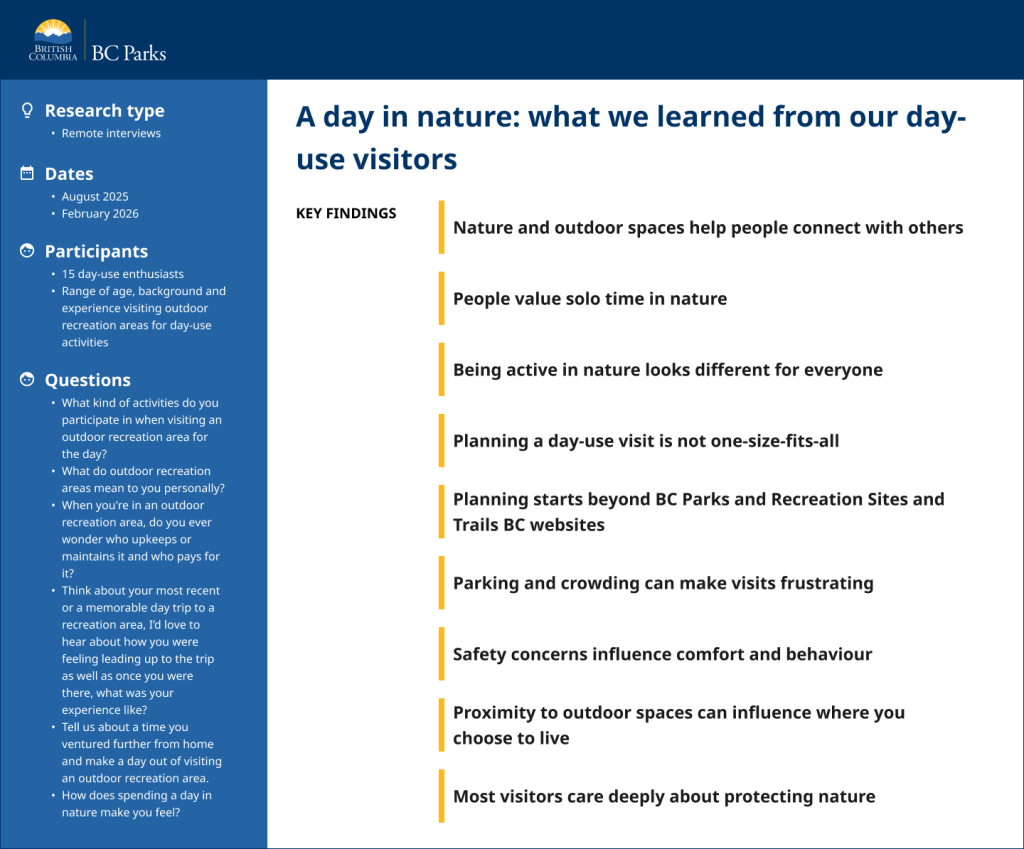
Nature and outdoor spaces help people connect with others
“When I’m with somebody else, I’m enjoying nature, but I’m also enjoying the relationship and the connection of who I’m with.” – Research participant
For most participants, many visits to outdoor recreation areas are about spending meaningful time with friends and family.
Outdoor spaces offer a welcoming, accessible space for gatherings across ages and abilities. Activities like picnicking, hiking, fishing, or exploring lakes are often rooted in childhood traditions or new rituals formed with loved ones.
“Once a month we have lunches at a park with the entire family, about 13 of us, kids play, adults chat.” – Research participant
People value solo time in nature
“I love being out there alone, carefree, enjoying the moment.” – Research participant
Being alone in nature serves several purposes for participants. It is a time to be active, get outside, and find a quiet place that feels restorative. People mentioned that this time can be for: stillness, mental reset, emotional processing, and self-connection.
Participants described outdoor recreation areas as places to pause, reset, and feel more like themselves. Being outside helped many participants manage stress, burnout, and emotional overload.
Some described nature as making life feel “more manageable,” when things get stressful. The effects were often described as physical and sensory: the smell of trees, the feeling of sand underfoot, or the quiet of a forest.
This extends to physical activity too. We heard consistently that being active in nature feels more meaningful than being active indoors. For example, participants describer outdoor movement as more enjoyable and more motivating than going to the gym.
Being active in nature looks different for everyone
“Going for a hike in the woods is my favourite way to get exercise.” – Research Participant
Participants described physical activity as something that looks different for everyone and changes over time. Staying active was not about achieving a specific goal or reaching the “hardest” destination. Instead, it was about choosing activities that matched their current abilities, interests, and energy levels.
For some, this meant short, regular walks close to home. For others, it meant longer hikes or more physically demanding outings. Many people fall somewhere in between, shifting depending on the season, their health, and what else is happening in their lives.
Planning a day-use visit is not one-size-fits-all
We asked people how they choose where to go and how much planning goes into a day-use visit. The answer was clear; planning depends on context.
People weigh a range of factors that determine how much planning is needed:
Proximity & time available: Short trips favour familiar outdoor recreation areas. They require less research and tend to be more spontaneous. Longer trips prompt more research. People often want a unique feature, somewhere new, access to water, or a challenging peak.
Who they’re with: Needs shift when visiting with children, older adults, or someone with limited mobility. Sometimes visitors have a list of reliable favourites they visit regularly. Other times they research to find the right recreation area that meets the need of everyone in the group.
Activities: Whether it’s a casual walk or a paddle boarding adventure, the activity determines what amenities matter and how much preparation is needed. Strenuous hikes, kayaking, mountain biking, or fishing involve specific gear and safety considerations. Visitors spend more time researching these trips, though still far less than for a camping trip.
Planning starts beyond BC Parks and Recreation Sites and Trails BC websites
“I don’t really look if it’s BC Parks or a Rec Site. I pick what fits the day.” – Research participant
The search for the right outdoor recreation area typically begins outside of the BC Parks and Recreation Sites and Trails websites. People often rely on recommendations from trusted friends and family and frequently revisit their favourite places.
When people are looking for somewhere new, they tend to use platforms such as:
- AllTrails
- Strava
- guidebooks
- printed or digital maps, and
- social media
Once they’ve chosen a place, they’ll check the BC Parks or Recreation Sites and Trails BC websites for key details like hours, rules, dog policies, parking, and safety information.
Many people keep personal lists of places, using spreadsheets, phone notes, custom maps, or even paper maps printed at home.
Parking and crowding can make visits frustrating
“I want to go to escape, I don’t enjoy being sardines.”– Research participant
We heard parking challenges are more common in the Lower Mainland, Squamish, Whistler, and the Tri-Cities. High fees and limited spots cause some people to avoid popular areas or visit during off-peak times.
Crowding can lessen the feeling of being in nature, lead to rule breaking, and cause environmental damage. Local residents often avoid tourist hotspots during peak months. For some, overcrowding can trigger feelings of stress and anxiety, undermining the quiet, space, and solitude they are looking for. As a result, some people will avoid their favourite outdoor recreation areas and opt for something less crowded.
Safety concerns influence comfort and behaviour
Participants spoke about safety in two distinct ways: human-related concerns and wildlife concerns.
Human-related concerns can discourage people from visiting
“My wife pulled into a place to go for a swim, and she just left, didn’t feel comfortable getting out with the run-down campers.” – Research participant
Some participants reported human-related safety concerns. Reports of syringes and people camping at neighbourhood parks have altered how families use these spaces.
Several participants noted a growing presence of people staying long-term in day-use areas. They’d often see the same trailers parked for months. This has led some visitors to avoid these outdoor recreation areas out of concern for personal safety.
Wildlife risks are expected and well understood
Wildlife encounters were described very differently. Participants widely accepted wildlife as part of being outdoors and recognized that visiting these areas means entering animal habitats.
Unlike human-related safety concerns, the presence of wildlife did not deter people from visiting outdoor recreation areas. Instead, it was seen as a normal and manageable part of the experience.
Proximity to outdoor spaces can influence where you choose to live
“A huge part of the decision to move to B.C. was the outdoor recreation opportunities, parks and proximity to the ocean.” – Research participant
Choosing where to live, especially when thinking about raising a family, is a big decision. For many people, access to outdoor spaces plays a surprisingly important role in that choice.
One participant stated the choice was not about finding the most luxurious home. It was about whether the neighbourhood was walkable and had outdoor recreation areas nearby.
The lifestyle that B.C. offers can also be a major draw. We heard from some participants who moved to B.C. specifically for a more outdoor-oriented way of life.
Most visitors care deeply about protecting nature
“Social trails and trail braiding, it will take a long time for earth to heal from that.”– Research participant
Participants express strong environmental awareness, including concerns about:
- Invasive species
- Trail damage and overuse
- Alpine vegetation impact
- Climate-related changes
Sustainability was a guiding principle that influenced how people choose where to go, how they behave while there, and what changes they hope to see in the future. Many people actively pick up garbage, seeing stewardship as a personal obligation. Some carry bags on outings, educate others, remove waste, and practice “leave no trace”.
What’s next?
Come check out our Day-use Styles that have resulted from the research with day-use visitors, which are archetypes that complement the Camping Styles. These archetypes represent groups of visitors and may include visitors’ guiding principles, inner thinking, emotional reactions, behaviours, goals, and pain points. They can be a valuable tool to help our teams consider different visitor perspectives when making decisions.
We will be conducting additional research in the future with day-use visitors to learn about day-use activities like fishing, climbing and boating.
More design research posts
Interested in design research at BC Parks and RSTBC? Read our previous design research posts.
How can you take part in our research?
Volunteer for one-on-one research sessions
We’re always looking for people who would like to take part in our design research activities. If you’re interested in one-on-one research, you can sign up using this form.
We contact people from our volunteer list at random, so we cannot promise that you will be selected for this type of research.