Who visits outdoor recreational spaces in B.C.? Day-use Styles help us get to know our visitors
Categories:
In July 2025, we created Camping Styles to better understand who our campers are. Using the same research approach, we’ve now developed Day‑use Styles to complement the Camping Styles and reflect the experiences of people visiting a park or recreation site but not staying overnight (referred to as day-use visitors).
It’s virtually impossible to optimize services, digital products, and policies for users when you don’t know who they really are. Though we’ve been speaking directly with visitors for several years, we wanted to learn more about what makes the experiences of day-use visitors unique.
For example, who are the people who visit parks and recreation areas? What motivates them to get outdoors? And what is their experience when they get there?
In this post, we share what we learned from 15 conversations with a variety of day-use visitors. These learnings have shaped a set of user types that we call Day-use Styles. Day-use Styles are a valuable tool for teams across our organization to use when making decisions that impact our visitors.
What Day-use Styles are (and are not)
Day-use Styles are inspired by Thinking Styles
The idea for Day-use Styles came from Thinking Styles, a method developed by strategic researcher and author Indi Young. It’s a way to dig beneath behaviours and preferences to understand users on a deeper level.
Day-use Styles are visitor archetypes
They shine a light on the different ways people approach their day-use experiences in B.C. They help us understand how visitors think, their emotional reactions, and guiding principles.
Day-use Styles are based on research
They are not fictionalized characters. We created them by finding patterns in what real people told us about how they approach and experience their outdoor recreation trips.
Day-use Styles help us empathize and understand
They are a tool to help us expand our idea of who day-use visitors are and what they need. This is especially useful when making decisions that impact visitors directly.
Day-use Styles are not demographics
They do not divide along lines such as age, gender, ethnicity, or physical abilities. Each style includes people from a variety of demographics.
Day-use Styles are not rigid
One person does not always equal one Day-use Style. People’s Day-use Style can change depending on context. For example, if one weekend you’re enjoying a walk alone, and the next weekend you’re at a picnic with extended family, it’s likely that you’re a different Day-use Style on each weekend.
Day-use Styles are not perfect
They are designed to evolve as we learn more about our visitors. Our current styles represent what we know so far, but as we talk to more people, the styles will change along with our knowledge.
Meet our Day-use Styles
So far, we’ve uncovered three distinct Day-use Styles, to which we’ve (hopefully) given memorable names.
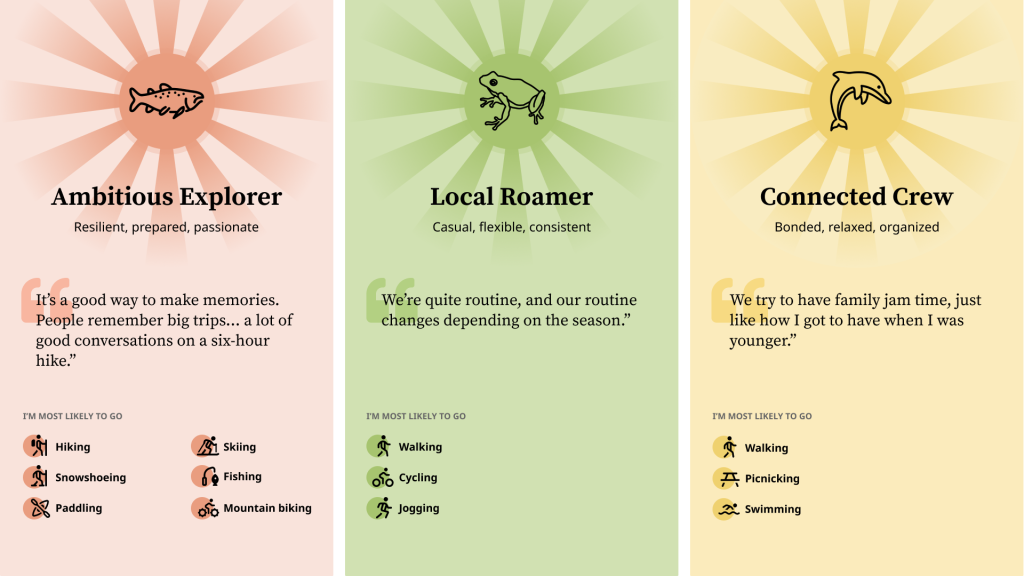
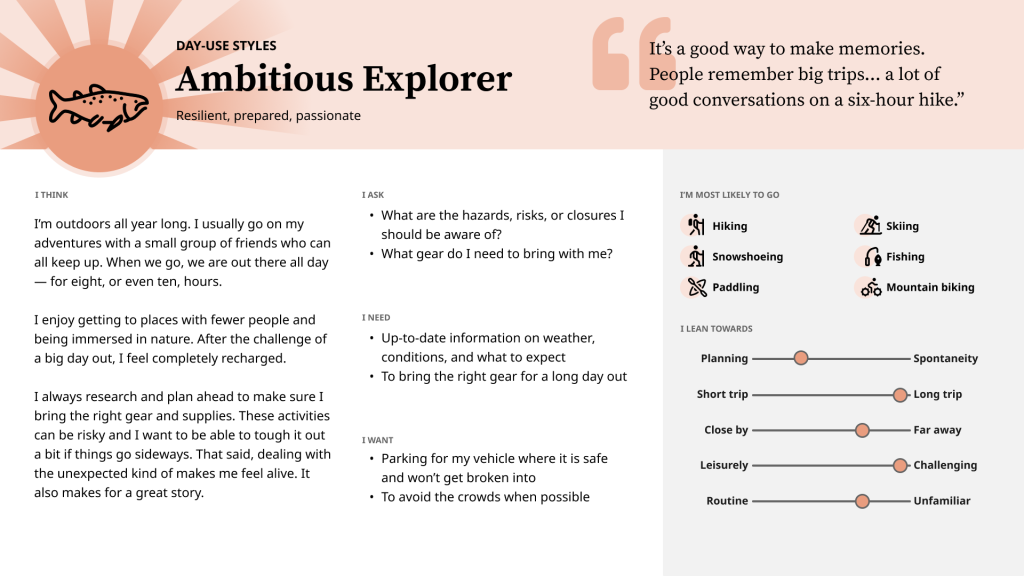
Ambitious Explorer
Resilient, prepared, passionate
“It’s a good way to make memories. People remember big trips… a lot of good conversations on a six-hour hike.”
The Ambitious Explorer is outdoors all year long. They enjoy going on adventures with friends and a challenge is part of the fun. They look for places with fewer people and love to be immersed in nature. They make the most of it and are out all day.
Most likely to go: hiking, snowshoeing, paddling, skiing, fishing, or mountain biking.
Lean towards planning, long trips, farther away from home, challenging and finding unfamiliar places.
Represented by the salmon spending lots of energy to navigate a long, difficult journey upstream.
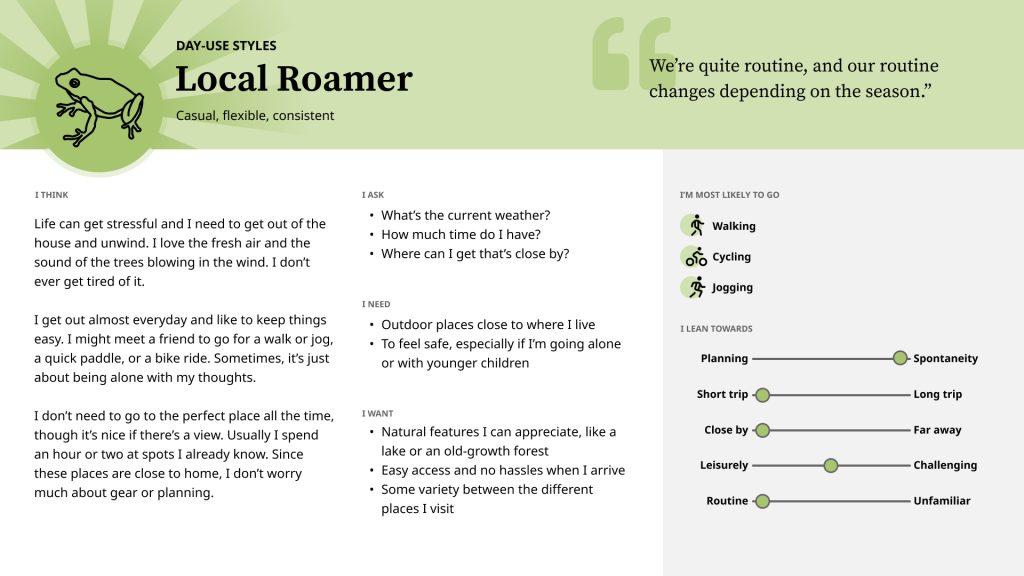
Local Roamer
Casual, flexible, consistent
“We’re quite routine, and our routine changes depending on the season.”
The Local Roamer likes to get outdoors to feel refreshed and recharged. They are out in nature almost every day. A short walk alone or a meeting a close friend fulfills their needs. They don’t need the perfect place every time and are just as happy to go somewhere familiar and close by.
Most likely to go walking, cycling, or jogging
Lean towards spontaneity and shorter trips to somewhere close by, generally seeking a quiet experience to somewhere familiar.
Represented by the frog, local to many areas across the province.
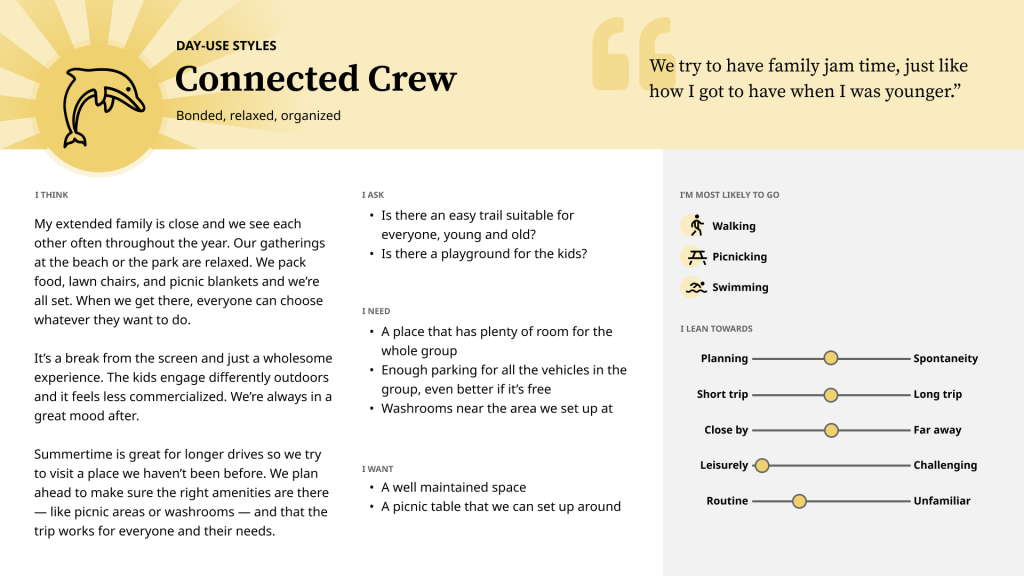
Connected Crew
Bonded, relaxed, organized
“We try to have family jam time, just like how I got to have when I was younger.”
The Connected Crew loves to get together with a big group of friends and family to enjoy the outdoors. Experiences are typically rooted in tradition and happen every year. They are open to finding new places if it meets the requirements of their large group with varying needs. What’s important is being together.
Most likely to go walking, picnicking, or swimming
Lean towards socializing and moderate planning, are adaptable and can stay close to home or venture further to find a new gem.
Represented by the dolphin, seeking togetherness and staying connected in their pods.
We can’t do this without you!
We’d like to say a huge thank you to everyone who took part in our Day-use Styles research. If you haven’t spoken to us yet, we’re always looking for people who would like to take part in future design research activities. If you’re interested in sharing your thoughts and experiences about outdoor recreation in B.C., please sign up.