
Contrast between reservoir levels in B.C. compared to those in the United States
32. Why are we repeatedly told that the low water levels are the result of flood control and requirement of the Treaty to release 5500 m3/s when you may have heard the there is a drought from Mexico to the Yukon? No need for any flood control this year, levels could have been kept at 1440 since last February! Also, 5500 m3/s is a joke, as up to 58000 m3/s has been released from the Arrow Lakes this summer and now due to the extreme low levels now 680 m3/s are being realised! Meantime water is spilled and wasted in the U.S.A.!
Answer from BC Hydro: Under the terms of the Columbia River Treaty, BC Hydro is required to continue sending water to the U.S. during dry periods. BC Hydro did not send any more water than what is absolutely required, to meet legal Treaty obligations and this was managed and reviewed daily as part of forecasts and operations planning. There is no provision under the Treaty for Canada to hold back additional water during drought conditions.
Although the lowest possible release of water rate is 5,000 cubic feet per second (ft3/s), this does not mean this is all that BC Hydro is required to release. Discharges at 5,000 ft3/s would only be expected when the Treaty requires that more water is held in Canadian storage. A recent example is the week of February 10, 2024, when discharges from Arrow Lakes Reservoir were reduced to 5,000 ft3/s due to the atmospheric river event in the U.S., which resulted in significant inflows for the U.S. portion of the basin.
33. If both countries were to share benefits equitably, why does the U.S. have full lakes and reservoirs and Arrow Lake is empty. How is this fair or equitable?
Answer from the B.C. Columbia River Treaty Team: The objective of the power coordination provision in the current Treaty is to optimize electricity generation in the U.S. The downstream power benefits are shared between the two countries by way of the Canadian Entitlement.
Water that would have flowed from Arrow Lakes Reservoir to Lake Roosevelt and through Grand Coulee Dam was likely kept in Lake Roosevelt this year to prepare for winter power generation needs. Additionally, flows from Lake Roosevelt are often released through Grand Coulee Dam later in the year to enhance downstream salmon populations.
The Canadian negotiation delegation is seeking improvements to a modernized Treaty that not only reflects a fair, equitable sharing of benefits, but also reduces impacts to the B.C. portion of the Basin.
34. How can the Grand Coulee Dam light show be justified from May long weekend to September 30 every evening during a drought year or any year? It doesn't appear this waste of water is part of the CRT.
That light show flows water for approximately 39 minutes everyday day during those months.
It is also tough to think we are in drought when they spill water over Coulee for a light show every night during summer.
It would also be appreciated to know that we are holding the U.S. accountable for their water waste with the Grand Coulee Dam nightly water wasting show. Totally unnecessary in a drought year.
Answer from the B.C. Columbia River Treaty Team: The Treaty does not oblige the U.S. to use water in any particular way. In fact, under the Treaty, both countries are able to use water for their own domestic purposes. Once water flows across the border, the U.S. can manage it for any downstream purposes.
35. The treaty was designed for flood control and power generation; therefore why is the water diverted from Grand Coulee Dam to IRRIGATE their dry barren land, to plant and sell crops? Irrigation was not part of the Treaty agreement.
Answer from the B.C. Columbia River Treaty Team: Under the Treaty, both countries can use water for their own domestic purposes, including to support irrigation, navigation, and fisheries. Once the water crosses the border, the U.S. can manage it to meet any number of domestic objectives.
Canada, B.C. and the Ktunaxa, Secwépemc and Syilx Okanagan Nations are seeking changes in the Treaty through negotiations with the U.S. that recognize the many ways the U.S. benefits from B.C.’s Treaty flow regulation.
36. Where is this drought that you keeping talking about? The Columbia River to the Tri-cities in Washington State has been full all summer and we have nothing. WHY?
Answer from BC Hydro: In 2023, British Columbia experienced severe drought conditions. Drought levels in the Upper and Lower Columbia Basins ranged from drought levels 3 to 5 for the majority of the summer, which was similar to conditions across much of the province. For reference, please see Figure 2.
[caption id="attachment_10187" align="alignnone" width="1024"]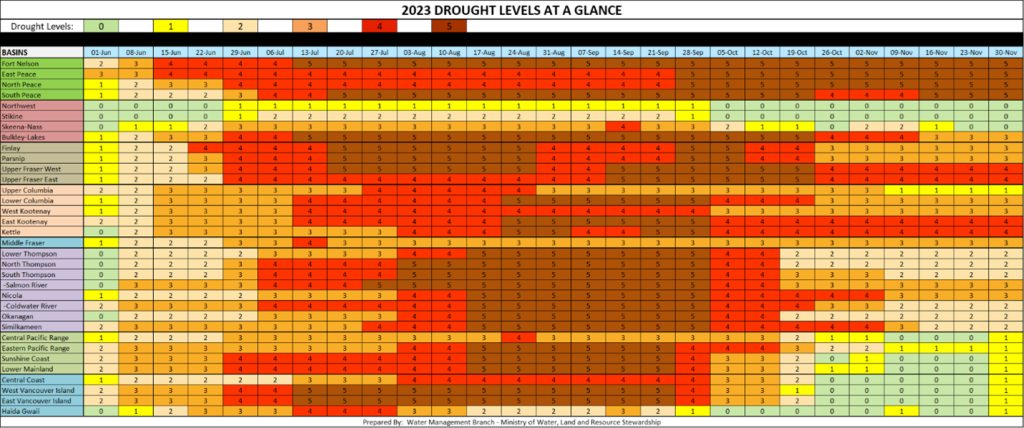 Figure 2: 2023 Drought Levels at a Glance, prepared by Water Management Branch - Ministry of Water, Land and Resource Stewardship[/caption]
37. Provided the drought and all the catastrophes are real, why isn’t the pain shared across the border?? Why is it up to B.C. to suffer a drought and Washington state is business as usual?
Answer from the B.C. Columbia River Treaty Team: The Columbia River Treaty includes legal requirements that must be met unless the Treaty is terminated, or a modernized Treaty is in place. This includes the requirement B.C. has to provide a certain volume of water to the U.S. throughout the year for flood-risk management purposes and downstream hydropower generation. In addition, Canada (B.C.) is required to release more water during dry conditions in the U.S. to enable the U.S. to meet their firm energy requirements.
The Canadian negotiation delegation is strongly advocating for improvements in the Treaty, though its negotiations with the U.S., to help mitigate the type of impacts we’ve seen on Arrow Lakes Reservoir this year. Two key goals for the Canadian team are to gain more flexibility for how B.C.’s Treaty dams are operated, and to incorporate adaptive management into the Treaty, which will help both countries to adjust to the effects of climate change (including droughts and floods), evolving Indigenous and scientific knowledge, and other future unknowns.
38. Enough misuse of water by the US. As their desert land flourishes our land becomes desert land with frequent and unbearable dust storms. What will the new treaty bring for our area?
Answer from the B.C. Columbia River Treaty Team: The current Treaty requires B.C. to provide a certain volume of water to the United States throughout the year for flood-risk management purposes and downstream hydropower generation. Beyond that, both countries can use water for their own domestic purposes.
As Canada and the U.S. seek to modernize the Treaty, they are looking at different ways of managing the volume and timing of water releases to support a wider range of interests in both countries.
The Canadian negotiation delegation, which includes Canada, B.C. and the Ktunaxa, Secwépemc and Syilx Okanagan Nations, is strongly advocating for improvements to the Treaty that could reduce the types of impacts we’ve seen on Arrow Lakes Reservoir this year.
One of the priorities for the Canadian negotiating team is to gain increased flexibility for how B.C.’s Treaty dams are operated. The additional flexibility could allow B.C. to adjust operations to support ecosystems, Indigenous cultural values, and socio-economic interests in the B.C. Basin, without agreement from the U.S. There is significant research and river management scenario modelling underway that is informing how best to use any new flexibility. Part of this process includes looking at different elevations throughout the year on Arrow Lakes Reservoir. Research to determine objectives for the modelling process is being led by the Ktunaxa, Secwépemc, and Syilx Okanagan Nations in collaboration with federal and provincial governments, the Columbia River Treaty Local Governments Committee, and environmental non-governmental scientists and technical consultants.
The Canadian delegation is also aiming to incorporate adaptive management into the Treaty, allowing both countries to adjust to the effects of climate change (including droughts and floods), evolving Indigenous and scientific knowledge, and other future unknowns.
39. It seems to me that the U.S. is diverting water for irrigation from its reservoirs and expecting us to maintain their levels with added water (Arrow Lakes) for Hydro. Is anything being done to correct this?
Answer from the B.C. Columbia River Treaty Team: Under the Treaty, B.C. is required to send a certain volume of water to the U.S. throughout the year for flood risk management and power generation purposes only. Beyond that, both countries can use water for their own domestic purposes, which includes irrigation, so once the water crosses the border, the U.S. can determine how it’s used. Canada/B.C. is not required to maintain specific reservoir elevations south of the border, regardless of how the U.S. manages the water. Once B.C. releases the volume of water required under the Treaty, its obligations have been met.
As part of negotiations to modernize the Treaty, the Canadian and U.S. delegations are looking at different ways of managing the volume and timing of water releases to support a wider range of interests in both countries.
One of the priorities for the Canadian negotiating team is to gain increased flexibility for how B.C.’s Treaty dams are operated. The additional flexibility could allow B.C. to adjust operations to support ecosystems, Indigenous cultural values, and socio-economic interests in the B.C. Basin, without agreement from the U.S. There is significant research and river management scenario modelling underway that is informing how best to use any new flexibility. Part of that research includes looking at different elevations throughout the year on Arrow Lakes Reservoir. Research to determine objectives for the modelling process is being led by the Ktunaxa, Secwépemc, and Syilx Okanagan Nations in collaboration with federal and provincial governments, the Columbia River Treaty Local Governments Committee, and environmental non-governmental scientists and technical consultants.
The Canadian delegation is also aiming to incorporate adaptive management into the Treaty, allowing both countries to adjust to the effects of climate change (including droughts and floods), evolving Indigenous and scientific knowledge, and other future unknowns.
The Canadian Entitlement is half of the additional potential hydroelectric power that could be produced in the U.S. as a result of how B.C. operates its Treaty dams. It is calculated in advance using formulas included in the Treaty. The U.S. returns this power to Canada in the form of electricity at the Canada-U.S. border in B.C. Powerex, the marketing and trading subsidiary of BC Hydro, sells the Canadian Entitlement at market value to either BC Hydro or utilities in Alberta or United States. Revenues from the Canadian Entitlement are paid to the Province and go into its general revenue fund.
Figure 2: 2023 Drought Levels at a Glance, prepared by Water Management Branch - Ministry of Water, Land and Resource Stewardship[/caption]
37. Provided the drought and all the catastrophes are real, why isn’t the pain shared across the border?? Why is it up to B.C. to suffer a drought and Washington state is business as usual?
Answer from the B.C. Columbia River Treaty Team: The Columbia River Treaty includes legal requirements that must be met unless the Treaty is terminated, or a modernized Treaty is in place. This includes the requirement B.C. has to provide a certain volume of water to the U.S. throughout the year for flood-risk management purposes and downstream hydropower generation. In addition, Canada (B.C.) is required to release more water during dry conditions in the U.S. to enable the U.S. to meet their firm energy requirements.
The Canadian negotiation delegation is strongly advocating for improvements in the Treaty, though its negotiations with the U.S., to help mitigate the type of impacts we’ve seen on Arrow Lakes Reservoir this year. Two key goals for the Canadian team are to gain more flexibility for how B.C.’s Treaty dams are operated, and to incorporate adaptive management into the Treaty, which will help both countries to adjust to the effects of climate change (including droughts and floods), evolving Indigenous and scientific knowledge, and other future unknowns.
38. Enough misuse of water by the US. As their desert land flourishes our land becomes desert land with frequent and unbearable dust storms. What will the new treaty bring for our area?
Answer from the B.C. Columbia River Treaty Team: The current Treaty requires B.C. to provide a certain volume of water to the United States throughout the year for flood-risk management purposes and downstream hydropower generation. Beyond that, both countries can use water for their own domestic purposes.
As Canada and the U.S. seek to modernize the Treaty, they are looking at different ways of managing the volume and timing of water releases to support a wider range of interests in both countries.
The Canadian negotiation delegation, which includes Canada, B.C. and the Ktunaxa, Secwépemc and Syilx Okanagan Nations, is strongly advocating for improvements to the Treaty that could reduce the types of impacts we’ve seen on Arrow Lakes Reservoir this year.
One of the priorities for the Canadian negotiating team is to gain increased flexibility for how B.C.’s Treaty dams are operated. The additional flexibility could allow B.C. to adjust operations to support ecosystems, Indigenous cultural values, and socio-economic interests in the B.C. Basin, without agreement from the U.S. There is significant research and river management scenario modelling underway that is informing how best to use any new flexibility. Part of this process includes looking at different elevations throughout the year on Arrow Lakes Reservoir. Research to determine objectives for the modelling process is being led by the Ktunaxa, Secwépemc, and Syilx Okanagan Nations in collaboration with federal and provincial governments, the Columbia River Treaty Local Governments Committee, and environmental non-governmental scientists and technical consultants.
The Canadian delegation is also aiming to incorporate adaptive management into the Treaty, allowing both countries to adjust to the effects of climate change (including droughts and floods), evolving Indigenous and scientific knowledge, and other future unknowns.
39. It seems to me that the U.S. is diverting water for irrigation from its reservoirs and expecting us to maintain their levels with added water (Arrow Lakes) for Hydro. Is anything being done to correct this?
Answer from the B.C. Columbia River Treaty Team: Under the Treaty, B.C. is required to send a certain volume of water to the U.S. throughout the year for flood risk management and power generation purposes only. Beyond that, both countries can use water for their own domestic purposes, which includes irrigation, so once the water crosses the border, the U.S. can determine how it’s used. Canada/B.C. is not required to maintain specific reservoir elevations south of the border, regardless of how the U.S. manages the water. Once B.C. releases the volume of water required under the Treaty, its obligations have been met.
As part of negotiations to modernize the Treaty, the Canadian and U.S. delegations are looking at different ways of managing the volume and timing of water releases to support a wider range of interests in both countries.
One of the priorities for the Canadian negotiating team is to gain increased flexibility for how B.C.’s Treaty dams are operated. The additional flexibility could allow B.C. to adjust operations to support ecosystems, Indigenous cultural values, and socio-economic interests in the B.C. Basin, without agreement from the U.S. There is significant research and river management scenario modelling underway that is informing how best to use any new flexibility. Part of that research includes looking at different elevations throughout the year on Arrow Lakes Reservoir. Research to determine objectives for the modelling process is being led by the Ktunaxa, Secwépemc, and Syilx Okanagan Nations in collaboration with federal and provincial governments, the Columbia River Treaty Local Governments Committee, and environmental non-governmental scientists and technical consultants.
The Canadian delegation is also aiming to incorporate adaptive management into the Treaty, allowing both countries to adjust to the effects of climate change (including droughts and floods), evolving Indigenous and scientific knowledge, and other future unknowns.
The Canadian Entitlement is half of the additional potential hydroelectric power that could be produced in the U.S. as a result of how B.C. operates its Treaty dams. It is calculated in advance using formulas included in the Treaty. The U.S. returns this power to Canada in the form of electricity at the Canada-U.S. border in B.C. Powerex, the marketing and trading subsidiary of BC Hydro, sells the Canadian Entitlement at market value to either BC Hydro or utilities in Alberta or United States. Revenues from the Canadian Entitlement are paid to the Province and go into its general revenue fund.
Figure 2: 2023 Drought Levels at a Glance, prepared by Water Management Branch - Ministry of Water, Land and Resource Stewardship[/caption]
37. Provided the drought and all the catastrophes are real, why isn’t the pain shared across the border?? Why is it up to B.C. to suffer a drought and Washington state is business as usual?
Answer from the B.C. Columbia River Treaty Team: The Columbia River Treaty includes legal requirements that must be met unless the Treaty is terminated, or a modernized Treaty is in place. This includes the requirement B.C. has to provide a certain volume of water to the U.S. throughout the year for flood-risk management purposes and downstream hydropower generation. In addition, Canada (B.C.) is required to release more water during dry conditions in the U.S. to enable the U.S. to meet their firm energy requirements.
The Canadian negotiation delegation is strongly advocating for improvements in the Treaty, though its negotiations with the U.S., to help mitigate the type of impacts we’ve seen on Arrow Lakes Reservoir this year. Two key goals for the Canadian team are to gain more flexibility for how B.C.’s Treaty dams are operated, and to incorporate adaptive management into the Treaty, which will help both countries to adjust to the effects of climate change (including droughts and floods), evolving Indigenous and scientific knowledge, and other future unknowns.
38. Enough misuse of water by the US. As their desert land flourishes our land becomes desert land with frequent and unbearable dust storms. What will the new treaty bring for our area?
Answer from the B.C. Columbia River Treaty Team: The current Treaty requires B.C. to provide a certain volume of water to the United States throughout the year for flood-risk management purposes and downstream hydropower generation. Beyond that, both countries can use water for their own domestic purposes.
As Canada and the U.S. seek to modernize the Treaty, they are looking at different ways of managing the volume and timing of water releases to support a wider range of interests in both countries.
The Canadian negotiation delegation, which includes Canada, B.C. and the Ktunaxa, Secwépemc and Syilx Okanagan Nations, is strongly advocating for improvements to the Treaty that could reduce the types of impacts we’ve seen on Arrow Lakes Reservoir this year.
One of the priorities for the Canadian negotiating team is to gain increased flexibility for how B.C.’s Treaty dams are operated. The additional flexibility could allow B.C. to adjust operations to support ecosystems, Indigenous cultural values, and socio-economic interests in the B.C. Basin, without agreement from the U.S. There is significant research and river management scenario modelling underway that is informing how best to use any new flexibility. Part of this process includes looking at different elevations throughout the year on Arrow Lakes Reservoir. Research to determine objectives for the modelling process is being led by the Ktunaxa, Secwépemc, and Syilx Okanagan Nations in collaboration with federal and provincial governments, the Columbia River Treaty Local Governments Committee, and environmental non-governmental scientists and technical consultants.
The Canadian delegation is also aiming to incorporate adaptive management into the Treaty, allowing both countries to adjust to the effects of climate change (including droughts and floods), evolving Indigenous and scientific knowledge, and other future unknowns.
39. It seems to me that the U.S. is diverting water for irrigation from its reservoirs and expecting us to maintain their levels with added water (Arrow Lakes) for Hydro. Is anything being done to correct this?
Answer from the B.C. Columbia River Treaty Team: Under the Treaty, B.C. is required to send a certain volume of water to the U.S. throughout the year for flood risk management and power generation purposes only. Beyond that, both countries can use water for their own domestic purposes, which includes irrigation, so once the water crosses the border, the U.S. can determine how it’s used. Canada/B.C. is not required to maintain specific reservoir elevations south of the border, regardless of how the U.S. manages the water. Once B.C. releases the volume of water required under the Treaty, its obligations have been met.
As part of negotiations to modernize the Treaty, the Canadian and U.S. delegations are looking at different ways of managing the volume and timing of water releases to support a wider range of interests in both countries.
One of the priorities for the Canadian negotiating team is to gain increased flexibility for how B.C.’s Treaty dams are operated. The additional flexibility could allow B.C. to adjust operations to support ecosystems, Indigenous cultural values, and socio-economic interests in the B.C. Basin, without agreement from the U.S. There is significant research and river management scenario modelling underway that is informing how best to use any new flexibility. Part of that research includes looking at different elevations throughout the year on Arrow Lakes Reservoir. Research to determine objectives for the modelling process is being led by the Ktunaxa, Secwépemc, and Syilx Okanagan Nations in collaboration with federal and provincial governments, the Columbia River Treaty Local Governments Committee, and environmental non-governmental scientists and technical consultants.
The Canadian delegation is also aiming to incorporate adaptive management into the Treaty, allowing both countries to adjust to the effects of climate change (including droughts and floods), evolving Indigenous and scientific knowledge, and other future unknowns.
The Canadian Entitlement is half of the additional potential hydroelectric power that could be produced in the U.S. as a result of how B.C. operates its Treaty dams. It is calculated in advance using formulas included in the Treaty. The U.S. returns this power to Canada in the form of electricity at the Canada-U.S. border in B.C. Powerex, the marketing and trading subsidiary of BC Hydro, sells the Canadian Entitlement at market value to either BC Hydro or utilities in Alberta or United States. Revenues from the Canadian Entitlement are paid to the Province and go into its general revenue fund.
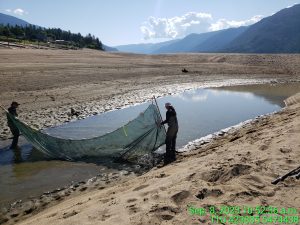 Photo: Crews work to salvage fish from stranding pools along the shorelines of Arrow Lakes Reservoir, September 2023. Submitted by BC Hydro.[/caption]
96. We are used to water level drops in the Arrow Lakes area. What is alarming is the rate of water released in gallons per day that was done during spawning season. Can an explanation be given for the rapid release of water during spawning season?
Answer from BC Hydro: Under the terms of the Columbia River Treaty, BC Hydro is required to continue to release water to the U.S. during periods of dry conditions. BC Hydro did not send any more water than what is absolutely required, and this was managed and reviewed daily as part of inflow forecasts and operations planning. BC Hydro and the U.S. coordinated additional storage in the spring of 2023 to support higher Arrow levels from May through June. However, any water stored in the spring was later released from July through mid-August to meet U.S. domestic needs as required under the agreement.
97. Is BC Hydro going to fund a fish ladder at Grand Coulee with their 8 billion profit last year?
Answer from BC Hydro: Fish passage in the U.S. portion of the Columbia basin is the responsibility of the U.S. government.
98. Will there be any initiatives to improve spawning channels on more creeks along the Arrow Lakes?
Answer from the B.C. Ministry of Water, Land and Resource Stewardship: The Hill Creek Spawning Channel provides enhanced spawning habitat for Arrow Lakes Reservoir and compensates for significant spawning habitat lost upstream of Revelstoke dam. Collectively, spawning habitat is not limiting for Arrow reservoir kokanee. Creating more spawning channel habitat elsewhere is not expected to improve overall kokanee outcomes. However, there are issues with spawner access and habitat for some of the smaller spawning tributaries which are of concern to the Province and BC Hydro. Those issues will not be resolved by constructing spawning channels but rather through site specific habitat improvement measures where feasible. Unfortunately, in years with low tributary flows into the reservoir due to climatic conditions (e.g. drought), particularly in combination with low reservoir levels, access to spawning habitat in some tributaries cannot be resolved through habitat improvement.
99. What is being done to address the low water levels and the impact to our fish and overall habitat loss in the Valley? The loss is extreme and should never be allowed to happen again. What is the plan moving forward?
Answer from BC Hydro: The Fish & Wildlife Compensation Program (FWCP) is a partnership between BC Hydro, the Province of B.C., Fisheries and Oceans Canada, First Nations and public stakeholders to conserve and enhance fish and wildlife in watersheds impacted by existing BC Hydro dams.
The FWCP is funded annually by BC Hydro. The FWCP directs those funds towards priority actions across its three regions to fulfil its mission and work towards its vision of thriving fish and wildlife populations in watersheds that are functioning and sustainable. The Fish & Wildlife Compensation Program conserves and enhances fish and wildlife in watersheds impacted by BC Hydro dams.
Although fish stranding is not an uncommon occurrence and can happen in any year, BC Hydro recognizes that the impacts were more significant under last year’s operating conditions. BC Hydro documented all reports of fish stranding on Arrow Lakes Reservoir during last year’s drought conditions. In addition, to minimize impacts to fish, crews were deployed to assess stranding sites and salvage fish where possible. 530 kilometres of shoreline were assessed to identify pools and focus ground surveys and salvage efforts, and 159 pools were sampled at 26 different sites.
Answer from the B.C. Ministry of Water, Land and Resource Stewardship: The Province, the Fish and Wildlife Compensation Program, and BC Hydro also surveyed creek mouths in advance of spawning migration to assess passage as well as collecting additional water temperature data. Ground and aerial counts for kokanee are complete and information indicates the kokanee spawner return increased compared to recent years and that fish were able to access the tributaries where the majority of fish in Arrow Lakes Reservoir return to spawn.
Answer from the B.C. Columbia River Treaty Team: Canada, B.C. and the Ktunaxa, Secwépemc and Syilx Okanagan Nations are seeking improvements in the Treaty through negotiations with the U.S. to reduce the type of impacts we’ve seen on Arrow Lakes this past year. The additional flexibility the Canadian negotiation delegation is seeking would allow B.C. to adjust its Treaty dam operations to support ecosystems (including fish), Indigenous cultural values, and socio-economic interests. There is river management scenario modelling underway that is informing how to use any new flexibility. Part of this involves looking at different elevations throughout the year on Arrow Lakes Reservoir. Research to determine objectives for this modelling process is being led by the Ktunaxa, Secwépemc and Syilx Okanagan Nations in collaboration with federal and provincial governments, the Columbia River Treaty Local Governments Committee and environmental non-governmental scientists and technical consultants.
100. Were there any environmental and/or biological studies completed in August and September 2023 relating to the impact low water levels have had regarding fish spawning, stranded fish in pools, mortality, and before and after fish population data (for the time periods of August to September 2023)?
Answer from BC Hydro: Although fish stranding is not an uncommon occurrence and can happen in any year, BC Hydro recognizes that the impacts were more significant under last year’s operating conditions. BC Hydro documented all reports of fish stranding on Arrow Lakes Reservoir during last year’s drought conditions. In addition, to minimize impacts to fish, crews were deployed to assess stranding sites and salvage fish where possible. 530 kilometres of shoreline were assessed to identify pools and focus ground surveys and salvage efforts, and 159 pools were sampled at 26 different sites.
Answer from the B.C. Ministry of Water, Land and Resource Stewardship: The Province, the Fish and Wildlife Compensation Program, and BC Hydro also surveyed creek mouths in advance of spawning migration to assess passage as well as collecting additional water temperature data. Ground and aerial counts for kokanee are complete and information indicates the kokanee spawner return increased compared to recent years and that fish were able to access the tributaries where the majority of fish in Arrow Lakes Reservoir return to spawn.
101. What are your plans to mitigate the impacts of rapid volume release of water during spawning periods?
Answer from BC Hydro: Under the terms of the Columbia River Treaty, BC Hydro is required to continue sending water to the U.S. during periods of dry conditions. BC Hydro did not send any more water than what is absolutely required, and this was managed and reviewed daily as part of inflow forecasts and operations planning. Unfortunately, BC Hydro does not have the unilateral rights to hold back flows for Canadian fisheries objectives without agreement from its U.S. counterparts.
The operation of Arrow Lakes Reservoir follows the Lower Columbia Fish Stranding protocol to help minimize impacts on fish by coordinating fish salvage response if needed during a flow reduction or implementing ramp rates as required to manage flow changes.
Although fish stranding is not an uncommon occurrence and can happen in any year, BC Hydro recognizes that the impacts were more significant under last year’s operating conditions. BC Hydro documented all reports of fish stranding on Arrow Lakes Reservoir during last year’s drought conditions. In addition, to minimize impacts to fish, crews were deployed to assess stranding sites and salvage fish where possible. 530 kilometres of shoreline were assessed to identify pools and focus ground surveys and salvage efforts, and 159 pools were sampled at 26 different sites.
Answer from the B.C. Ministry of Water, Land and Resource Stewardship: The Province, the Fish and Wildlife Compensation Program, and BC Hydro also surveyed creek mouths in advance of spawning migration to assess passage as well as collecting additional water temperature data. Ground and aerial counts for kokanee are complete and information indicates the kokanee spawner return increased compared to recent years and that fish were able to access the tributaries where the majority of fish in Arrow Lakes reservoir return to spawn. The Province through the FWCP enumerates kokanee spawners annually as a component of the Arrow Lakes Reservoir Nutrient Restoration Program and the Hill Creek Spawning Channel.
Answer from the B.C. Columbia River Treaty Team: As part of negotiations to modernize the Treaty, Canadian and U.S. delegations are looking at different ways of managing the volume and timing of water releases to support a wide range of interests in both countries, including fish spawning and other ecosystems objectives.
102. What future plans are being considered to avoid rapid water level drops (volume per day released through the dam)?
Answer from BC Hydro: Under the terms of the Columbia River Treaty, BC Hydro is required to continue sending water to the U.S. during periods of dry conditions. Last summer and fall, BC Hydro did not send any more water than what is absolutely required, and this was managed and reviewed daily as part of inflow forecasts and operations planning. Unfortunately, BC Hydro does not have the unilateral rights to hold back flows for Canadian objectives without agreement from its U.S. counterparts.
Answer from the B.C. Columbia River Treaty Team: As part of negotiations to modernize the Treaty, Canadian and U.S. delegations are looking at different ways of managing the volume and timing of water releases to support a wide range of interests in both countries. Further details are confidential as negotiations are still underway; however, before any agreement is finalized, we will explain to Basin residents what is being proposed and seek feedback.
Photo: Crews work to salvage fish from stranding pools along the shorelines of Arrow Lakes Reservoir, September 2023. Submitted by BC Hydro.[/caption]
96. We are used to water level drops in the Arrow Lakes area. What is alarming is the rate of water released in gallons per day that was done during spawning season. Can an explanation be given for the rapid release of water during spawning season?
Answer from BC Hydro: Under the terms of the Columbia River Treaty, BC Hydro is required to continue to release water to the U.S. during periods of dry conditions. BC Hydro did not send any more water than what is absolutely required, and this was managed and reviewed daily as part of inflow forecasts and operations planning. BC Hydro and the U.S. coordinated additional storage in the spring of 2023 to support higher Arrow levels from May through June. However, any water stored in the spring was later released from July through mid-August to meet U.S. domestic needs as required under the agreement.
97. Is BC Hydro going to fund a fish ladder at Grand Coulee with their 8 billion profit last year?
Answer from BC Hydro: Fish passage in the U.S. portion of the Columbia basin is the responsibility of the U.S. government.
98. Will there be any initiatives to improve spawning channels on more creeks along the Arrow Lakes?
Answer from the B.C. Ministry of Water, Land and Resource Stewardship: The Hill Creek Spawning Channel provides enhanced spawning habitat for Arrow Lakes Reservoir and compensates for significant spawning habitat lost upstream of Revelstoke dam. Collectively, spawning habitat is not limiting for Arrow reservoir kokanee. Creating more spawning channel habitat elsewhere is not expected to improve overall kokanee outcomes. However, there are issues with spawner access and habitat for some of the smaller spawning tributaries which are of concern to the Province and BC Hydro. Those issues will not be resolved by constructing spawning channels but rather through site specific habitat improvement measures where feasible. Unfortunately, in years with low tributary flows into the reservoir due to climatic conditions (e.g. drought), particularly in combination with low reservoir levels, access to spawning habitat in some tributaries cannot be resolved through habitat improvement.
99. What is being done to address the low water levels and the impact to our fish and overall habitat loss in the Valley? The loss is extreme and should never be allowed to happen again. What is the plan moving forward?
Answer from BC Hydro: The Fish & Wildlife Compensation Program (FWCP) is a partnership between BC Hydro, the Province of B.C., Fisheries and Oceans Canada, First Nations and public stakeholders to conserve and enhance fish and wildlife in watersheds impacted by existing BC Hydro dams.
The FWCP is funded annually by BC Hydro. The FWCP directs those funds towards priority actions across its three regions to fulfil its mission and work towards its vision of thriving fish and wildlife populations in watersheds that are functioning and sustainable. The Fish & Wildlife Compensation Program conserves and enhances fish and wildlife in watersheds impacted by BC Hydro dams.
Although fish stranding is not an uncommon occurrence and can happen in any year, BC Hydro recognizes that the impacts were more significant under last year’s operating conditions. BC Hydro documented all reports of fish stranding on Arrow Lakes Reservoir during last year’s drought conditions. In addition, to minimize impacts to fish, crews were deployed to assess stranding sites and salvage fish where possible. 530 kilometres of shoreline were assessed to identify pools and focus ground surveys and salvage efforts, and 159 pools were sampled at 26 different sites.
Answer from the B.C. Ministry of Water, Land and Resource Stewardship: The Province, the Fish and Wildlife Compensation Program, and BC Hydro also surveyed creek mouths in advance of spawning migration to assess passage as well as collecting additional water temperature data. Ground and aerial counts for kokanee are complete and information indicates the kokanee spawner return increased compared to recent years and that fish were able to access the tributaries where the majority of fish in Arrow Lakes Reservoir return to spawn.
Answer from the B.C. Columbia River Treaty Team: Canada, B.C. and the Ktunaxa, Secwépemc and Syilx Okanagan Nations are seeking improvements in the Treaty through negotiations with the U.S. to reduce the type of impacts we’ve seen on Arrow Lakes this past year. The additional flexibility the Canadian negotiation delegation is seeking would allow B.C. to adjust its Treaty dam operations to support ecosystems (including fish), Indigenous cultural values, and socio-economic interests. There is river management scenario modelling underway that is informing how to use any new flexibility. Part of this involves looking at different elevations throughout the year on Arrow Lakes Reservoir. Research to determine objectives for this modelling process is being led by the Ktunaxa, Secwépemc and Syilx Okanagan Nations in collaboration with federal and provincial governments, the Columbia River Treaty Local Governments Committee and environmental non-governmental scientists and technical consultants.
100. Were there any environmental and/or biological studies completed in August and September 2023 relating to the impact low water levels have had regarding fish spawning, stranded fish in pools, mortality, and before and after fish population data (for the time periods of August to September 2023)?
Answer from BC Hydro: Although fish stranding is not an uncommon occurrence and can happen in any year, BC Hydro recognizes that the impacts were more significant under last year’s operating conditions. BC Hydro documented all reports of fish stranding on Arrow Lakes Reservoir during last year’s drought conditions. In addition, to minimize impacts to fish, crews were deployed to assess stranding sites and salvage fish where possible. 530 kilometres of shoreline were assessed to identify pools and focus ground surveys and salvage efforts, and 159 pools were sampled at 26 different sites.
Answer from the B.C. Ministry of Water, Land and Resource Stewardship: The Province, the Fish and Wildlife Compensation Program, and BC Hydro also surveyed creek mouths in advance of spawning migration to assess passage as well as collecting additional water temperature data. Ground and aerial counts for kokanee are complete and information indicates the kokanee spawner return increased compared to recent years and that fish were able to access the tributaries where the majority of fish in Arrow Lakes Reservoir return to spawn.
101. What are your plans to mitigate the impacts of rapid volume release of water during spawning periods?
Answer from BC Hydro: Under the terms of the Columbia River Treaty, BC Hydro is required to continue sending water to the U.S. during periods of dry conditions. BC Hydro did not send any more water than what is absolutely required, and this was managed and reviewed daily as part of inflow forecasts and operations planning. Unfortunately, BC Hydro does not have the unilateral rights to hold back flows for Canadian fisheries objectives without agreement from its U.S. counterparts.
The operation of Arrow Lakes Reservoir follows the Lower Columbia Fish Stranding protocol to help minimize impacts on fish by coordinating fish salvage response if needed during a flow reduction or implementing ramp rates as required to manage flow changes.
Although fish stranding is not an uncommon occurrence and can happen in any year, BC Hydro recognizes that the impacts were more significant under last year’s operating conditions. BC Hydro documented all reports of fish stranding on Arrow Lakes Reservoir during last year’s drought conditions. In addition, to minimize impacts to fish, crews were deployed to assess stranding sites and salvage fish where possible. 530 kilometres of shoreline were assessed to identify pools and focus ground surveys and salvage efforts, and 159 pools were sampled at 26 different sites.
Answer from the B.C. Ministry of Water, Land and Resource Stewardship: The Province, the Fish and Wildlife Compensation Program, and BC Hydro also surveyed creek mouths in advance of spawning migration to assess passage as well as collecting additional water temperature data. Ground and aerial counts for kokanee are complete and information indicates the kokanee spawner return increased compared to recent years and that fish were able to access the tributaries where the majority of fish in Arrow Lakes reservoir return to spawn. The Province through the FWCP enumerates kokanee spawners annually as a component of the Arrow Lakes Reservoir Nutrient Restoration Program and the Hill Creek Spawning Channel.
Answer from the B.C. Columbia River Treaty Team: As part of negotiations to modernize the Treaty, Canadian and U.S. delegations are looking at different ways of managing the volume and timing of water releases to support a wide range of interests in both countries, including fish spawning and other ecosystems objectives.
102. What future plans are being considered to avoid rapid water level drops (volume per day released through the dam)?
Answer from BC Hydro: Under the terms of the Columbia River Treaty, BC Hydro is required to continue sending water to the U.S. during periods of dry conditions. Last summer and fall, BC Hydro did not send any more water than what is absolutely required, and this was managed and reviewed daily as part of inflow forecasts and operations planning. Unfortunately, BC Hydro does not have the unilateral rights to hold back flows for Canadian objectives without agreement from its U.S. counterparts.
Answer from the B.C. Columbia River Treaty Team: As part of negotiations to modernize the Treaty, Canadian and U.S. delegations are looking at different ways of managing the volume and timing of water releases to support a wide range of interests in both countries. Further details are confidential as negotiations are still underway; however, before any agreement is finalized, we will explain to Basin residents what is being proposed and seek feedback.