
Wetlands in B.C. are under increasing development pressures. It is important to explore opportunities to maintain these valuable natural assets. This post explores whether and how to strengthen the application of the environmental mitigation hierarchy under the Water Sustainability Act (WSA). This would be done to support more predictable, transparent, and effective permitting processes, leading to improved wetland outcomes while fostering sustainable economic development.
Requiring the application of the mitigation hierarchy, or ensuring that its steps are followed, is expected to provide clarity and improve processes and outcomes. Your input is invited on whether, how, when and where such requirements can and should apply, as well as what guidance and tools can support effective implementation.
What is the mitigation hierarchy?
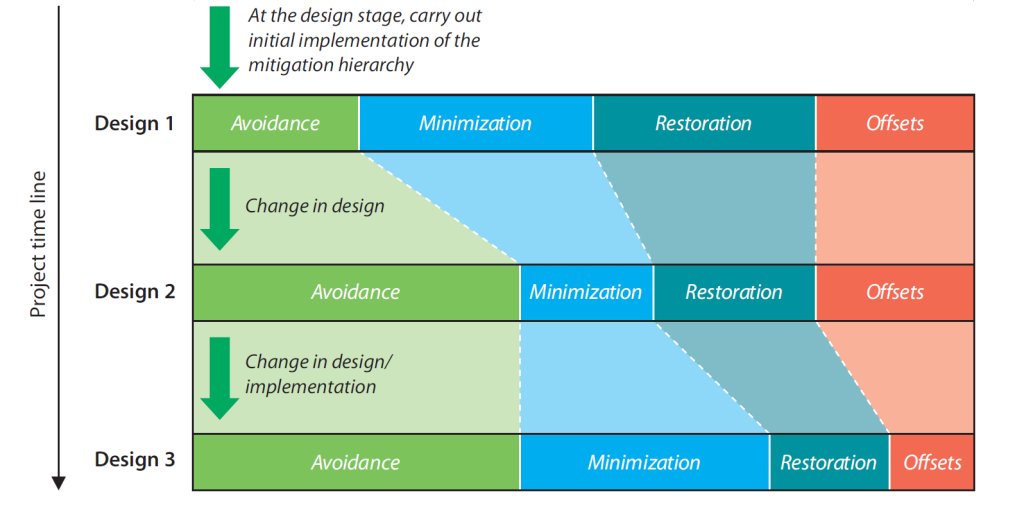
British Columbia’s Environmental Mitigation Policy (EMP) endorses the mitigation hierarchy, a globally recognized framework to manage environmental impacts. Since its introduction in 2014, it has been applied across B.C. on a range of projects with different kinds of environmental impacts. The mitigation hierarchy is a step-by-step approach where all reasonable measures should be considered and applied at one level before moving to the next:
- Avoid impacts wherever possible
- Minimize impacts that cannot be avoided
- Restore on-site environmental values
- Offset residual impacts as a last resort
What’s the challenge?
Because applicants aren’t required to show they’ve taken all reasonable steps in the mitigation hierarchy, there are challenges for permitting efficiency and environmental outcomes for wetlands, including:
- Lack of clarity and consistency: There is uncertainty in the application process. Applicants aren’t always sure what’s expected of them regarding moving through the steps of the mitigation planning and decision-makers find it challenging to set and enforce consistent expectations when reviewing applications.
- Limited consideration of Avoid and Minimize: Mitigation plans tend to focus on compensation measures first, before fully exploring opportunities to avoid and minimize impacts. When “Avoid” and “Minimize” are overlooked in the mitigation hierarchy or delayed in project planning, cost-effective and environmental solutions can be missed.
- Delays and increased costs: Applications that don’t fully address the mitigation hierarchy often lead to extended review timelines, more back-and-forth with regulators, and higher costs for applicants.
- Less effective environmental outcomes: Ultimately, project design and mitigations may not be informed to the extent possible, resulting in poorer outcomes
What’s being proposed?
To address these challenges, a proposed solution is to ensure the mitigation hierarchy is applied for changes in and about wetlands under the WSA. The goal is that applications would describe which reasonable measures were explored to avoid and minimize impacts, before the consideration of restoration on-site. Consideration of offsetting any remaining impacts would be the last step.
At the same time, the Province intends to develop mitigation guidance specific to wetlands. This will complement the EMP, providing science-based support for consistent mitigation planning and decision-making that can be adaptable to site-specific needs.
Moving from the current approach to a clear requirement to apply the mitigation hierarchy in applications, supported by wetland-specific mitigation guidance, is expected to lead to:
- Consistent and fair application of the mitigation hierarchy: Offers clearer expectations for proponents and regulators under the WSA, reducing inconsistency and improving the overall quality of applications and environmental outcomes for wetlands.
- Improve transparency and public trust: Allows for more consistent mitigation planning and compliance.
- Improved permitting processes: Clearer expectations can result in more comprehensive and accurate applications, leading to faster, more predictable permitting processes.
- Improved environmental outcomes: Improved stewardship of wetlands by limiting and/or compensating for project impacts, while supporting sustainable development.
- Cost savings: Earlier planning and prioritizing avoidance and minimization of impacts can reduce permit delays, lower legal risks, and decrease the need for costly compensation measures later in the process.
By considering whether to require the application of the mitigation hierarchy, B.C. can potentially build a more predictable, transparent, and effective system for wetland management. Such a shift could support protection of wetlands and encourage sustainable economic growth.
We want to hear from you
Your feedback will help shape this proposal:
- What challenges and opportunities do you see in requiring the application of the mitigation hierarchy under the WSA?
- How might requiring the application of the mitigation hierarchy under the WSA impact you, your organization or your community?
- What other solutions should be considered to address the challenges described in this post?
Thank you for your feedback.
The survey closed December 12, 2025.
Learn more about our other identified opportunities to improve natural resource permitting on the govTogetherBC website.