
The provincial guidance on environmental mitigation (reducing impacts) and applying the environmental mitigation hierarchy is provided in the B.C. Environmental Mitigation Policy (EMP) and the B.C. Environmental Mitigation Policy Procedures (Procedures) known together as the “EMP Policy and Procedures”. These documents include details on habitat offsets and in-lieu payments (“ILPs”), also called “in-lieu fee mitigation”, “financial compensation”, or “offset payments.” We are proposing to use “offset payments” as part of upcoming updates to EMP documents, hence why we refer here to “offset payments”.
What is the mitigation hierarchy?
The mitigation hierarchy is a globally recognized framework to manage environmental impacts using a step-by-step approach where all reasonable measures should be considered and applied at one level before moving to the next:
- Avoid impacts wherever possible
- Minimize impacts that cannot be avoided
- Restore on-site environmental values
- Offset residual impacts as a last resort
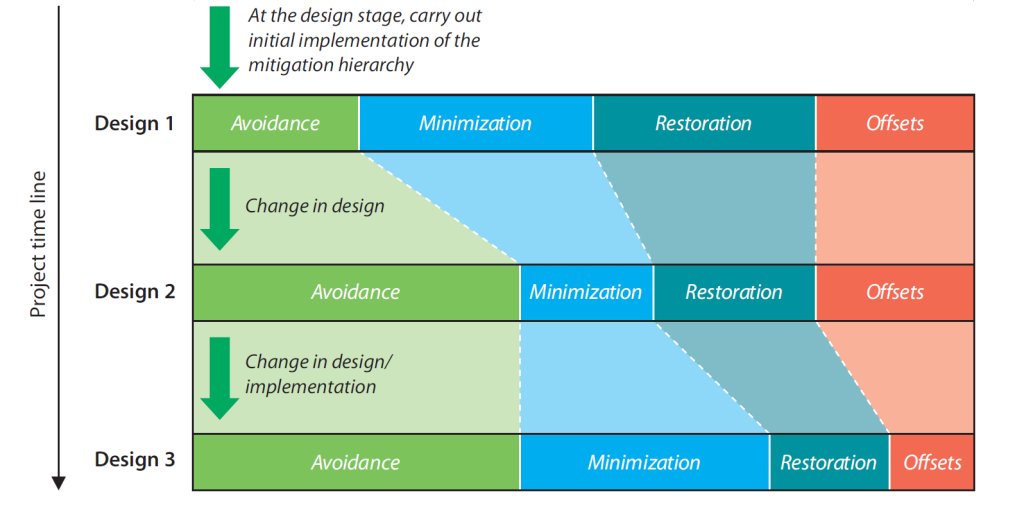
All conservation actions in response to the mitigation hierarchy are also known as compensatory measures, whether these range from the avoidance of loss to limiting damage, or restoring and rehabilitating sites. There is another post discussing the application of the mitigation hierarchy for impacts to wetlands, which is also seeking public feedback.
Introduction to offsets
Generally, offsetting is the final step of the environmental mitigation hierarchy. It is done after all other measures to fully avoid, minimize, and restore on-site have been considered and when ecological impacts remain. Offsets are the conservation actions to compensate for the unavoidable, residual damage of the proposed activity.
Offsets and the relation to offset payments
An offset payment is a subset, or one type, of offsets. It is a payment made by a person proposing a project or activity, to fund offsetting measures (conservation offsetting mechanisms).
Offsets and the Water Sustainability Act (WSA)
Some specific compensatory measures in relation to impacts to streams may be permissible under the Water Sustainability Act (WSA) where the proponent remains responsible for the conservation actions taken and where those actions address the loss and impact by their project or activity.
Under the WSA, a person proposing a project or activity that will have residual damage is required to show how that damage will be offset, either by measures to mitigate impacts on the affected stream/aquifer or, if the proponent agrees, on a different stream/aquifer.
The current focus is to explore how, when and whether a range of offsets including offset payments for wetlands, might be included under the WSA.
Implementing offsets
Conservation actions resulting from offsets can be implemented by either private participants, non-profits, or government-approved agencies.
The challenges
- Offsets are complex, and careful attention is needed at every stage from the initial consideration of whether offsets are appropriate, to design, to implementation, monitoring, and evaluation
- Because it is the last step in the mitigation hierarchy, there needs to be confidence that proponents are taking effective conservation actions and there is accountability for the outcomes
- There may be limits to the conservation actions a proponent can identify and implement when done on a project-by-project basis, especially in certain geographic areas
- There may be additional barriers to identifying and implementing effective conservation actions that are beyond the control of the proponent
- Should changes allow for offset payments related to impacts on wetlands, many factors might be considered when determining the cost of a wetland offset payments (such as restoration costs, land acquisition, long-term monitoring and adaptive management)
The opportunities
Many offset projects are selected based on land availability rather than where they can most effectively restore wetland values and functions. To address this, the Province is exploring the use of offset payments for wetlands to support a more consistent and strategic approach to compensation when impacts on wetlands are unavoidable. Offset payments for wetlands might help pool resources to target restoration efforts in areas that deliver the highest net benefits. This approach can support broader watershed outcomes as opposed to issuing funds across separate, less impactful projects.
Given the complexity and need to ensure there is effective offset implementation with the best outcomes, the focus is on continuous improvement. There is a possible opportunity to:
- Improve the design, adoption and effectiveness of offsets. This means improving efficiency and clarity in the process while also ensuring confidence in the system for environmental benefits.
- Build on jurisdictional experiences of offsets and different approaches of offset payments (examples include Alberta, Washington State and Queensland, Australia) B.C. may have an opportunity to improve previous models and learn from successes and challenges.
- Consider the benefits and flexibility needed to achieve broader conservation goals instead of only considering the impacts on a project-by-project, site-by-site basis.
We want to hear from you
The Province is considering all challenges and opportunities and welcomes your thoughts, concerns and ideas of how to improve the current system. Below are some questions to guide your input:
- What should the Province consider to make sure offset payments lead to the best possible outcomes for wetland conservation?
- Are there any considerations or criteria for when offset payments are not appropriate?
- Should offset payments only be considered for projects that impact wetlands?
- What safeguards and accountability mechanisms might be needed to support conservation outcomes when using wetland offset payments?
- In addition to existing governance structures, partnerships, or agreements in place, how should the Province best work with other governments (federal, local, First Nations) in deciding how and where offset payments for wetlands conversations are applied?
- What oversight and responsibility need to be in place to ensure the intended conservation benefits are achieved?
Thank you for your feedback.
The survey closed December 12, 2025.
Learn more about our other identified opportunities to improve natural resource permitting on the govTogetherBC website.